
When a parent starts struggling with a shower, buttoning a shirt, or getting safely out of bed, it can be hard to know what kind of help to look for. Many families hear the term personal care at home and aren’t sure what it covers or how it differs from medical care. Here’s a plain look at what this service is, who it’s for, and what a typical visit looks like.
The everyday tasks behind personal care
Personal care focuses on what clinicians call activities of daily living, or ADLs. These are the basic self-care tasks most adults handle without a second thought until age, illness, or injury makes them harder. A trained caregiver can help with:
- Bathing, showering, and sponge baths
- Dressing and undressing, including compression stockings
- Toileting and incontinence care
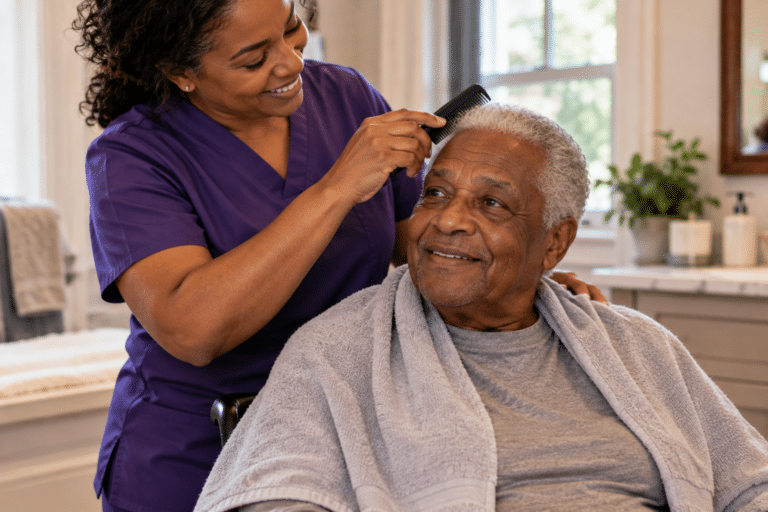
- Grooming, such as hair care, shaving, and oral hygiene
- Transfers, like moving from bed to chair or chair to toilet
- Walking and steadying a parent as they move around the house
- Eating, for seniors who need hands-on help at meals
Caregivers can also handle the tasks that keep a day running: light housekeeping, laundry, meal preparation, and medication reminders. A reminder is different from giving medication. A caregiver can prompt your mother to take her 9 a.m. pills, but in most states can’t decide doses or give injections.
What it doesn’t include
Personal care at home is non-medical. Caregivers don’t change sterile wound dressings, manage IV lines, or adjust medications. Those tasks belong to licensed nurses and therapists, usually through a home health agency under a doctor’s order. Many families use both at once: a nurse visits twice a week for wound care while a caregiver comes daily for bathing and meals.
The distinction matters for payment, too. Medicare generally doesn’t pay for ongoing custodial care, which is the official term for help with daily living when there’s no skilled medical need. Most families pay privately or use long-term care insurance, veterans benefits, or a Medicaid waiver program, depending on what they qualify for.
Who benefits most
Personal care fits a wide range of situations. Some seniors need help only with a morning shower a few days a week. Others need assistance with nearly every task after a stroke or as Parkinson’s disease progresses. Common reasons families call include:
- A recent fall, or a growing fear of falling in the bathroom
- Arthritis or weakness that makes dressing slow and painful
- Memory loss that causes a parent to skip bathing or wear the same clothes for days
- Recovery after surgery, such as a hip or knee replacement
- A spouse who has been the main helper and can’t keep up physically anymore
The bathroom deserves special mention. According to the CDC, about one in four adults age 65 and older falls each year, and wet bathroom floors are a frequent setting. Having a steady hand nearby during a shower lowers that risk.
What a typical visit looks like
Most agencies start with an in-home assessment, often led by a nurse or care manager. They’ll ask about your parent’s health, routines, preferences, and goals, then write a care plan. That plan tells the caregiver exactly what to do and when.
A morning visit might start with helping your dad out of bed, then a shower using a shower chair and grab bars, then shaving and getting dressed in clothes he picked out the night before. The caregiver might make breakfast, remind him about his medications, wipe down the bathroom, and start a load of towels before leaving. Visits can be as short as a few hours or as long as around-the-clock coverage.
Good caregivers follow your parent’s lead. If your mother has always showered at night, the schedule should reflect that. If she likes her hair set a certain way, the caregiver learns how. Small details like these make help feel less like an intrusion.
Questions to ask before you start
Before hiring help, ask the agency how caregivers are screened and trained, whether they’re employees or contractors, and who supervises them. Find out what happens when a caregiver calls in sick, and whether your parent will see a consistent caregiver rather than a rotating cast of strangers. Ask how often the care plan gets reviewed, since needs tend to change over months.
It’s also worth asking how the agency communicates with families. Many use care notes, phone updates, or an online family portal so adult children who live across town or across the country can see how each visit went.
Taking the first step
Accepting help with something as private as bathing is hard for many older adults. It’s often easier to start small, with a few visits a week focused on one task, and build from there as trust grows. The right support for personal care at home lets your parent stay in familiar surroundings while you worry less about the next fall or the next skipped shower.
If you’re unsure what level of help fits, a free assessment is a low-pressure way to get an outside opinion. You’ll come away with a clearer picture of your parent’s needs, whatever you decide. Families who explore personal care at home before a crisis usually have more options and less stress than those who wait.
If you or an aging loved one are considering personal care at home in Falls Church, VA, please contact the caring staff at Access Home Care Inc today! Call (703) 765-9350
Access Home Care provider in Arlington, Alexandria, Leesburg, Reston, Herndon, Manassas, Ashburn, Falls Church, McLean, Lorton, Springfield, Woodbridge, Fairfax, Virginia and the surrounding communities.

“My desire to enter into nursing started when one of my older sisters died of kidney disease due to lack of care. At age 15, I decided to enter into nursing so that I could provide quality care to patients.Upon arrival in United States at 21 years of age, I enrolled in T.C Willliams School of Practical Nursing while working as a nursing assistant at a nursing home. I also worked as a part-time home health aide to take of the elderly. After completion of my practical nurse education, I worked in geriatric psychiatry unit at Dominion Hospital and Arlington Correctional facility mental health unit.
I completed Marymount University in 2001 and entered into Home Care as a field case manager.
I held that position for 2 years and as an Administrator, and for another 2 years until Access Home Care was found in 2004."
Today, Access Home Care has over 300 employees and 286 clients.
- Help Managing Appointments, Daily Schedules for Aging Parents - November 4, 2026
- What Personal Care at Home Includes and How it Helps - October 20, 2026
- Who Will Care for Our Son When We Can’t? In-Home Care for Developmental Disabilities in Northern Virginia - October 6, 2026
